Hey! Here's my Intro to House Styles Video!
Commonly Found House Styles
While not exhaustive, I hope this provides a good overview of some of the basic styles here in MA. I'm glad you found this page, which has been one of the most popular here on the blog. Please note, that I think its a good idea - especially if you're in certain price ranges - to be open to various houses styles that might fit your needs - but that you aren't "used to". All houses have drawbacks, and positives, but finding the right mix of those for your situation is what makes a great match! Since a lot of people are particularly interested in what make a Cape different from a Colonial, those two are listed first.
Colonial House Style
 |
|
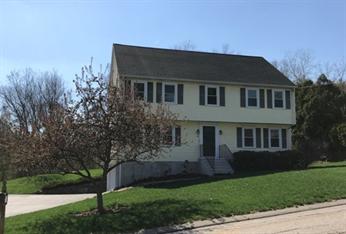
This Colonial type home is popular throughout Metrowest |
Colonials are the most popular house style. They've been around so long, that it can be useful to talk about the various sub-styles. These are not necessarily "official", but I find them useful. Antique Colonial, Garrison Colonial, Flat-front colonial and Contemporary colonial are good starting points. Antique colonials are homes that predate today's housing styles - anything earlier than 1940 is a good line in the sand to draw. Garrison Colonials
|
|
|
This Garrison Colonial is easily identified by the second floor hanging over the first floor. |
were popular in the 70's and 80's, and are easily recognizable by the fact that the top half hangs over the bottom half. Most colonials built today are the contemporary kind, and they are distinguished by the complicated roof lines and lack of a flat front. (Older colonials -50's and 60's -typically are flat all across the front and back). Any kind of colonial can have an attached garage or a garage under, which is usually determined by the builder to adjust to the slope of the lot (and to save money). While attached garages are usually preferred, similar colonials with attached garages command price premiums to homes with a garage under.
Cape House Style
Started right on Cape Cod, the classic cape was a three bedroom home with two beds upstairs and one downstairs, but over time developers built several different bedroom configurations for these homes, including 3 beds all up stairs, 2 up 2 down, and more recently, 4 beds upstairs. These homes have been popular since the 1940's, both for their curb appeal and their cheaper (than a colonial) costs. Today, there are relatively few differences between modern capes and colonials, except for one - the roof line generally interferes with the living space on the top floor.
|
|
|
Roof lines interfere with the top level in most capes. Dormers are common but not necessary. |
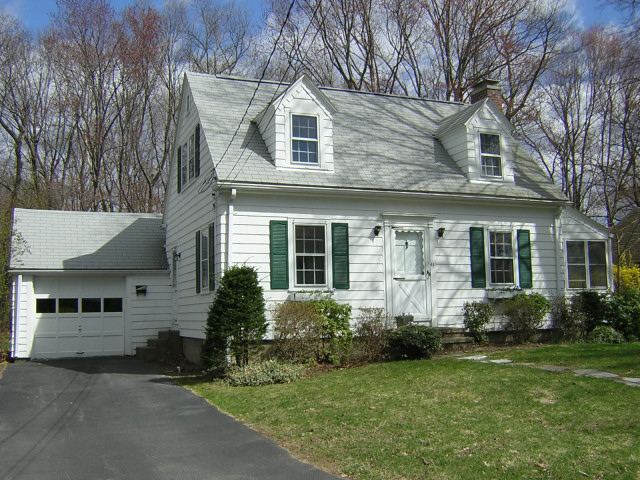
If the roof line has no affect on any upstairs rooms, it's a colonial, otherwise, it's a cape! Easy right? Smaller capes have very small bedrooms upstairs, which today's buyers no longer care for. Many Capes have It's not a question of age, though, as some older capes have very spacious rooms upstairs, and most need to be checked out up close to see for sure. If you can get a good side view of the Cape, you can often see how much space is probably upstairs, but don't forget many cape have rear dormers that significant expand the head room on Capes.
Ranch House Style
|
|
|
Ranches have just one main level. |

Ranches are desirable for their one-level living. Unlike Capes and colonials, ranches have the kitchen, bedrooms, and all living space on one level. Commonly built without basements in much of the country, the majority still have basements in New England. Ranches are expensive to build on a square foot basis, so as land costs increase, they are a less common choice for developers.
Split-Level House Style
|
|
|
Splits are easily identified by a door that is halfway between the first floor windows and the lower-level windows. |

Because of their practicality - low cost and large living space - the split-level home is alive and well in New England. Generally, you don't see too many until the 1960's, and they made up a lot of the stock in the 1970's and 1980's. Split level homes have ranch floor plans, but generally have additional living space in the lower-level. the hallmark of the split is the stairway - generally, the front door brings you to a landing that has a half flight of stairs up to the primary living area, and a half flight down to the garage, basement, and additional living space.
Raised Ranch
|
|
|
Raised Ranches have just two levels and they look like colonials a bit, but the kitchen and bedrooms are on the second floor. |
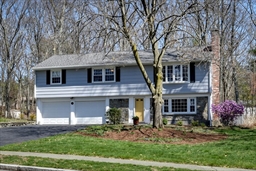
Often confused with the split, a true raised ranch is a home where the living area (kitchen, bedrooms, etc) is up a FULL flight of stairs. (So for those of you saying a split and a raised ranch are the same thing, technically they are not). Generally, these homes are built with garages and additional living area down stairs, but the whole house is basically upstairs, in a classic ranch pattern. Although a raised-ranch can be the right solution for a particular lot, they are unusual and less popular than other house styles. From the street, they look a lot like colonials, but the garage under the main floor next to the front door is hallmark of this home.
Antiques
|
|
|
This Large Victorian is easily spotted with the large amount of decorative trim and complex roof that adorns the outside. |
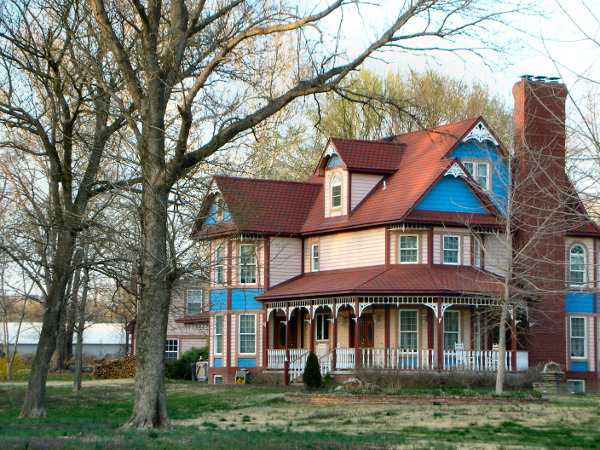
Older homes (those built before 1940) were, for the most part, built at a very individualized level. Although they share certain characteristics, with the passages of time and often countless renovations, predictions about the floor plan are often difficult to make. A generally useful description is Victorian (which typically involves some significant details on the inside and out) or farmhouse, which can be much simpler, less ornate homes. Farmhouses built before 1890 in this area often have post and beam construction of the period, and generally have some functional issues (low ceilings, etc) that reflect the limited house building technology of the period.
Multi-level
|
|
|
A Multi-level homes typically have the main living level where the front door is, and the bedrooms are a half flight up. It's not uncommon for bigger versions to have 4 levels of living space. |

The twisted cousin of the split, the less common multi-level typically has 3 or four levels of living, with each level separated by a half flight of stairs. Like split-levels, these homes often offer great usable space at a great price, and can be surprising practical. But aesthetically they aren't as popular, probably just because homeowners are used to other styles.
Multi-levels typically have the main level (kitchen, family room) even with the door - in contrast to splits where the door is neither on the main level or the lower level - and the bedrooms are usually up a level. There are usually three small bedrooms up there. Their can be one or two levels down from the main level as well, providing plenty of physical space.
Contemporary
These homes are often characterized by their different look, both inside and out. Inside, the main features are open spaces, vaulted ceilings, and large windows with lots of light. Unfortunately, the majority of them were built in the 1980's, and they suffer from stylistic choices of that period - vertical siding, dark wood trim, and windows that aren't as efficient or useful as today's modern windows. These homes still appeal, however, to those who are looking for something else, something different, and when brought up to modern day palettes, can be stunning show pieces.
Fun Fact
I have actually lived in 3 of the homes pictured! Can you guess which ones? Take a stab in the comments!
Don’t Go Just Yet! More Information for you…
- Dangers in the home: Which danger involves the greatest risk? Asbestos, CO, Radon, Lead Paint?
- How do interest rates affect the number of homes for sale and home prices?
- A final checklist before closing on your new home.
- Top 10 things people should know about Title Insurance.
- Updated summary report on residential property taxes. Where are you ranked?
- Interviewing Realtors? Here’s the inside scoop!
- Things every home buyer should know about Radon.
About Matt Heisler
Matt Heisler is a real-estate professional and owner of this website. He has been selling homes in MA for buyers and sellers for over 20 years. He is an expert in foreclosure purchases, short-sale purchases, short-sale sales, buy and hold investing, fix and flip investing, and of course traditional residential home sales. He is happy to take questions as they pertain to real estate on Title V, Radon, Termites, Sump Pumps, Roofs, Foundations, Wells, Septic Systems, Cash-Flow, Staging, and a host of other housing issues. As a Vanderbilt University alumnus, he is proud to serve his local community.
*All information is posted in good faith and is assumed to be reliable, but may rely on third party information sources.
