General Index 

General House Hunting Articles

Things about Housing Everyone Should Know

Good Towns for Buyers, Good Towns for Sellers

Home Buying, Step by Step

Common Housing Problems and What to Do

Financing

Common Expenses when Buying or Selling Homes

After You Move In

Remodeling Slideshows for Kitchens, Baths, and others!

Newsletters

June 24, 2016

Home Foundations : Fieldstone, Cinder block, and Poured Concrete

Fieldstone Has been Around for a Long

Time, but can be troublesome.

In New England, most homes have basements.  In many areas of the country, this is not so, but here, basements have been deemed desirable and are important features on a property.  But you can't have a basement without having a foundation.  There are three common types found, and for the folks new to buying homes, I'd thought I'd spotlight each in turn.

Fieldstone Foundations

Typically, you'll find fieldstone in many homes before 1935 or so.  Before the advent of widespread concrete, this was the de facto choice for a homes foundation.  Fieldstone, is, of course, "stones found in the field" or plain old rocks, stacked up and occasionally mortared until you can build a house on it.  When placed on a good base and solid earth, fieldstone can be a fine foundation.  After all,


the homes it's holding up are usually 100 years old or more!  But it does have drawbacks, and that's why it isn't used anymore as a foundation of choice.  It lacks the water resilience of poured concrete, and that means more water in the basement.  I have seen dry fieldstone basements, but not many.  Also, it is susceptible to "bowing" which is when the wall bends in or out (typically in), if there is structural weakness in the wall, or if there's pressure outside pushing in.  Although it provides great vertical strength, it's horizontal strength is not as good, which means if it's not on a good solid platform, (like sand) it won't hold up very well.  Although these foundations are plenty strong, there are reasons we don't use them today. 

Concrete Cinder Block Foundations

A major advance in foundation technology arrived with the Cinder block, or concrete block. Much cheaper and faster than building fieldstone. Very strong vertically, and the modular nature of it made it a natural for home building.  It has better (but still not great) ability to keep water out of your basement.  But cinder block does have some issues, which has limited its usefulness today.  First, it is similar to fieldstone in that it's horizontal strength is limited, and cracks in cinder block walls, typically seen as "step cracks", can highlight potential shifting or weaknesses in the surrounding ground.  Also, Cinder blocks are hollow, mostly, and this hollowness can allow insect infestations from ground borne insects to go undetected for some time.  This reason, although a rare occurrence, in New England, is likely why most town building codes no longer permit Cinder block for dwellings.

Poured Concrete Foundations

The standard for todays foundations, poured concrete has vertical and horizontal strength, very good water protection (but it is still porous, and as we all know will not prevent flooding), and when poured 18 inches or more above the outside grade, provides excellent insect protection.  Predominant by the 1960's, most homes will have this type of foundation.  Newer structures typically have the concrete go much higher above grade than in original applications, to help with insect repellent. Hope this is a useful summary.  Poured concrete can be just a slab, or it can be the walls underground for the basement. 


WHAT DOES TITLE V MEAN? 

Don’t Go Just Yet! More Information for you…

About Matt Heisler

Matt Heisler is a real-estate professional and owner of this website. He has been selling homes in MA for buyers and sellers for over 20 years. He is an expert in foreclosure purchases, short-sale purchases, short-sale sales, buy and hold investing, fix and flip investing, and of course traditional residential home sales. He is happy to take questions as they pertain to real estate on Title V, Radon, Termites, Sump Pumps, Roofs, Foundations, Wells, Septic Systems, Cash-Flow, Staging, and a host of other housing issues. As a Vanderbilt University alumnus, he is proud to serve his local community.

*All information is posted in good faith and is assumed to be reliable, but may rely on third party information sources.

June 24, 2016

How Can I Tell if the Basement Gets Water or If it Floods

Wish I had a nickel for each time I've been on this topic! I look at several things to try and get the best answer. I'll briefly cover Seller habits, Land Topography, Basement Type, and Direct Evidence in this post.


What do I Look for in the Basement to see if It gets Wet?

Generally, the easiest place to start in your water penetration detective work is the basement. You can look for direct evidence of water penetration by looking at the following.

A) Water. (oddly enough, water in the basement isn't always from flooding, but that's another post.)

B) Look for mineral deposits, or dirt around cracks on the concrete or foundation. Mineral deposits are often white, and scale easily if there's enough of them

C) Look for staining of water by any wood that is in permanent contact with the floor. I usually check the stairwell to see if the wood shows evidence of water or water staining. Many times, there's is evidence, but I really look for repeated water stains, replaced wood, rotted wood, etc.

D) Look for sump pumps. Folks, Sump pumps are almost always a good thing. They are a great way to get a basement that occasionally, or even frequently gets water to one that stays dry. But most people don't put them in preventively - it's almost always a response to an issue that happened at one point.


What might the sellers habits tell me about their basement?


I also like to look around at what the seller is doing about "water worry". People that have basements that get wet frequently are usually pretty careful about putting cardboard, books, paper, clothing, and other items that respond poorly to water on the floor. If they are expecting water, you'll see everything up on blocks, on metal shelves, etc. You won't see anything on the floor. Sometimes you can tell how long stuff has been in place, and in some basements, it looks like items have been on the floor for years. Clearly, the sellers aren't worried about flooding if that's the case.


What about the Lot? Can that tell me about Water Issues in the House

Water goes downhill, I think most of us know that. So if you home is at the top of a hill, you're usually in pretty good shape. There are exceptions to every rule of course! It's more of a concern when the home, or part of the home, is at the bottom of a hill. If it rains hard enough and long enough, that water is going to start


coming at your foundation awfully fast. When this is the case, I usually look outside, and look for evidence of perimeter drains (many of which are not visible) or other evidence that the water is pooling or not being directed away from the home.


What do different Foundation Types tell me about Water Penetration into the Basement


You can read more about different foundation types here, but in general, fieldstone is almost always going to have some water penetration issues, at least in wet parts of the world like Massachusetts. Even poured concrete however, is no guarantee (far from it!) as it is porous as well, and at best slows down the rate that water will come in.


What else Should I know about Water Penetration into the Basement

Well you should be aware that ANY basement can get flooded. Just because the previous owners had no problems doesn't mean you won't. Let's say that the previous owners had gutters and always cleaned them - but you forgot that first year. That might be the difference maker. Also, trees/shrubs planted close to the foundation grow over time and change absorption rates, or course New England is famous for huge swings in precipitation from day to day and year to year. Maybe you put in a pool, reducing the amount of absorption possible by your lot! Maybe your perimeter drain stops working. There are literally dozens of things that change from year to year, and if the conditions are right, you'll get wet.


Having said that, don't panic! Almost all basement can stay dry, or at least not flood, with good rainwater diversion techniques and routine maintenance, and occasionally specialized systems to deal with more severe problems. The goal when looking at homes is to try to make sure you're not walking into a issue without being aware of what the situation might be. In general, systemic water penetration is very difficult to conceal, and with these tips, you'll be in line to spot it.


Don’t Go Just Yet! More Information for you…

About Matt Heisler

Matt Heisler is a real-estate professional and owner of this website. He has been selling homes in MA for buyers and sellers for over 20 years. He is an expert in foreclosure purchases, short-sale purchases, short-sale sales, buy and hold investing, fix and flip investing, and of course traditional residential home sales. He is happy to take questions as they pertain to real estate on Title V, Radon, Termites, Sump Pumps, Roofs, Foundations, Wells, Septic Systems, Cash-Flow, Staging, and a host of other housing issues. As a Vanderbilt University alumnus, he is proud to serve his local community.

*All information is posted in good faith and is assumed to be reliable, but may rely on third party information sources.

June 24, 2016

What Should the Humidity in my Home Be?

What should the Humidity in my House Be?

The humidity in your house should be less than 50% relative humidity, but probably above 30%. Many of us don't have a hygrometer, or gauge for the humidity, in our home, so here's a quick tip to help keep you house at the right humidity. Check for condensation on your windows! Condensation indicates that moisture may be above ideal levels in your home.

Where does the moisture in my house come from?

Moisture can come from many places,

but proper humidity levels keep your

home a healthy place.

In the summer, moisture is most likely to come from the outside, which is very high in humidity, at least here in New England. But throughout the year, extra humidity can come from several different sources, including showers, cooking, and of course, humidifiers. In times past, the dry air of the winter often seeped into the cracks and gaps of older homes and dried them out, sometimes uncomfortably. But today, most homes have vapor barriers, tighter fitting windows, and overall have much less airflow between the inside and the outside.  This can create conditions where humidity can build up.

Why do I want to Control the Humidity in my House?

High levels of humidity create better environments for mold to grow. Mold, of course, is not something we want to be helping find a foothold in our home. Insects too will seek out moist environments. So it makes sense to keep your home at the right levels, to offer both health and home protection. You don't have to go overboard, it's a good thing to do, but I'm not advocating checking your humidity levels everyday!

How do I control the Humidity in My House?

Humidifiers, often used by parents to help sick children sleep, put moisture into the air and raise humidity levels. De-humidifiers do the reverse, they take moisture out of the air. Air conditioning also takes moisture out of the air as part of the


process of cooling the air. Part of the comfort of A/C in the summer isn't just the cooler temperatures, the drier air allows us to feel cooler as well. Many forced-air heat systems have humidifiers built in as well, and often have a humidistat that allows you to control the humidity in the house. If your home is too dry, adjust the humidistat or run a humidifier in your home.  If your home is too damp, run a dehumidifier.


Do Good Things Today!

Matt Heisler

Don’t Go Just Yet! More Information for you…

About Matt Heisler

Matt Heisler is a real-estate professional and owner of this website. He has been selling homes in MA for buyers and sellers for over 20 years. He is an expert in foreclosure purchases, short-sale purchases, short-sale sales, buy and hold investing, fix and flip investing, and of course traditional residential home sales. He is happy to take questions as they pertain to real estate on Title V, Radon, Termites, Sump Pumps, Roofs, Foundations, Wells, Septic Systems, Cash-Flow, Staging, and a host of other housing issues. As a Vanderbilt University alumnus, he is proud to serve his local community.

*All information is posted in good faith and is assumed to be reliable, but may rely on third party information sources.

June 24, 2016

WHAT DOES 'PASSED TITLE V', or 'TITLE V IN HAND' MEAN?

Passed Title V, Title V In Hand


A passed Title V means that the septic system has been recently inspected by a licensed septic inspector, and that the inspection indicated that the system has passed current standards, which are set by the state.

Title V is important - unless you're an

outdoors lover.

You should take the time to review the inspection, understand the system in place (they aren't all the same),  and evaluate it, using local experts where necessary. Local experts might include the local board of health, and other septic inspectors.  Not just anyone can do a septic inspection, you need to be licensed by the state, and the inspectors (generally) need approval from the local town as well. Who did the inspection is noted in the report, along with their license #, which is available on-line at mass.gov in the licenses section.  If you are unfamiliar with a Title V report, it is a good idea to talk to someone who is - not everyone is well versed in the language of septic!

The Importance of Title V

You wouldn't buy a house without knowing if the roof is in good shape or not, and a septic system works the same way. Unlike a roof though,  you can't "see" it, and I think it's this unknown quality of septic that gives buyers pause. It's an important - and expensive - system for you house, so you should carefully evaluate it.  Evaluating a septic system is not necessarily straightforward either - "old" is not necessarily "bad" and "new"  is not necessarily "good", although I have found that some people are quick to race to those determinations.

 Age is important though, but there are several other questions to ask.  Is there a back up leach field?  Did the primary field fail and when?  Are there pump records available?

Failed Title V

Should a home "fail" a Title V inspection, it is usually the seller's responsibility to replace the system. This is true even if the purchase contract was completed (with out language to the contrary) before the inspection was performed. (Note to Sellers: Get your inspection done before you list!!!).

It has become customary for sellers to be responsible for Title V for a simple reason; most banks won't lend on a property with a failed system. So when we see "seller responsibility" what it really means is "hard to borrow money against". As you can imagine, that significantly reduces the number of people who can purchase the property, so I often find that properties without a Title V can sell for 30-50K below the value they would if they had a functioning system. Most people who purchase have done a septic replacement before, and understand the in and outs, and that's a good thing - the process, while not overly complicated, is confusing to newbies, and is time consuming, expensive, and often involves a great deal of red tape. If you are looking for a good way to build equity, a septic replacement can be that way, just recognize that it will require solid financial backing on your part. 


If you're thinking of purchasing a home with a failed Title V, make sure to read this post.


Looking for information on how to keep your septic system ship shape?  I have more information in this article on Keeping Your Septic Running Smoothly.


Finding Professionals to Get a Title V, or to Service your Septic System

If you're looking for a professional to help you get your Title V report in Metrowest, we can put you in touch with reliable companies with sterling reputations in your area.  Please contact me for details at matt_heisler@heislerandmattson.com!  Two recommendations here though.


Northborough Septic: 


Lakeside Sewerage (Marlborough)


We often have coupons for Title V inspections - we run out fast, but shoot us an e-mail if you'd like to save a little $$.

Don’t Go Just Yet! More Information for you…

About Matt Heisler

Matt Heisler is a real-estate professional and owner of this website. He has been selling homes in MA for buyers and sellers for over 20 years. He is an expert in foreclosure purchases, short-sale purchases, short-sale sales, buy and hold investing, fix and flip investing, and of course traditional residential home sales. He is happy to take questions as they pertain to real estate on Title V, Radon, Termites, Sump Pumps, Roofs, Foundations, Wells, Septic Systems, Cash-Flow, Staging, and a host of other housing issues. As a Vanderbilt University alumnus, he is proud to serve his local community.

*All information is posted in good faith and is assumed to be reliable, but may rely on third party information sources.

June 24, 2016

Should I Buy a Home with Electric Heat?

If you're looking at housing in New England, you may occasionally come across homes from the (two) great oil shocks of the 70's. It seems like ancient history today, but when oil prices became a concern to the home buyer, builders responded, and in this case they responded by building homes that were heated by electricity, and not oil.


How does Electric Heat Work?

There are two types of Electric Heat, there's Electric Baseboard heat and Electric Radiant Heat. Both systems work by running an electric current through a resistance wire, which heats up. With Electric baseboard, the heated wire is behind a metal housing, attached to the wall where the baseboard is. Just like with forced hot water, it heats the air and as the air rises into the room, cool air rushes in underneath the vent, and the convection current helps to heat the room quite quickly. With Electric Radiant Heat, the resistance wire is embedded in either the floor or the ceiling, and it tends to heat the floor or ceiling, which then warms the air. While not as fast as electric baseboard, the warm floors created by radiant heat do have their advocates! (Today, when people want warm floors, they still use electric radiant heat or more complex systems of embedded hot water.) Most Space Heaters are also electric, and while they are as easy as plugging in a lamp for extra heat, can be expensive to operate and some require good ventilation to keep from overheating and potentially starting a fire.  Space heaters are generally not recommended as permanent solutions to heat your home for these reasons.


Advantages/Disadvantages of Electric Heat

There are some advantages to electric heat. First, just as it did in the 70's, it provides an alternative to oil, and is available everywhere, unlike gas. With the recent rise in oil prices to $4.00/gal, the difference between heating your home electrically and with oil is not as large as it use to be. The other advantages are that there is no "heat system" to fail, no burner or boiler to service, and that reduces long-term capital costs on your home. It is also very cheap to repair or replace, should a section of baseboard fail. (Fixing radiant heat, in the unlikely case that it breaks, is far more difficult, since it is often permanently embedded in the floor or ceiling. A surprising advantage of electric heat homes is they were often very well insulated, especially for the time period but even by today's standards.


The disadvantages start with the yearly electric bills. The last couple of decades have, for the most part, provided homeowners with cost-effective oil and gas, and made electric heat houses look very expensive to operate by comparison. In addition, where forced hot water and air systems are typically "zoned" one floor at a time, electric heat is typically done by room. Today, with many homes owners using programmable thermostats, this is less of an issue than it use to be, but many homes with electric heat that I see for sale are still using the original thermostat setup - meaning you need to adjust the heat each time you enter/leave a room. Although it seems like a minor annoyance, most people today would prefer not to think about their thermostat settings 10 times a day, so it certainly is an issue. Like forced hot air, many people complain that electric heat is very "drying", leaving the air uncomfortable. It's also, like forced hot water, completely incompatible with air conditioning.


Should I Pay More or Less for a Home with Electric Heat? Most buyers are so against electric heat that they are not even interested in looking at the math to determine the true "rational" cost. Many, many times I have told buyers that a prospective homes has electric heat to which they say, "Oh, then I don't want to see it". As far as I can tell, this heavily negative sentiment has been around for a long time. As I mentioned, oil heat homes are about twice as expensive to heat today as they were just five years ago, (electricity is up only marginally), so these homes should be more cost-effective, but at this time people are still unwilling to commit to them in large numbers, and most prospective buyers plan on retrofitting the home with a more modern heat system. For this reason, homes with electric heat often sell far below the prices of their contemporaries with more popular systems, and while it is certainly not a "mistake" to buy a home with electric heat, I would consider it a mistake if the buyer was not compensated appropriately. 10-40K is not an unusual discount for these homes.


Do Good Things Today! Matt Heisler

Don’t Go Just Yet! More Information for you…

About Matt Heisler

Matt Heisler is a real-estate professional and owner of this website. He has been selling homes in MA for buyers and sellers for over 20 years. He is an expert in foreclosure purchases, short-sale purchases, short-sale sales, buy and hold investing, fix and flip investing, and of course traditional residential home sales. He is happy to take questions as they pertain to real estate on Title V, Radon, Termites, Sump Pumps, Roofs, Foundations, Wells, Septic Systems, Cash-Flow, Staging, and a host of other housing issues. As a Vanderbilt University alumnus, he is proud to serve his local community.

*All information is posted in good faith and is assumed to be reliable, but may rely on third party information sources.

June 24, 2016

Home Buyers: Important Next Steps after you Sign an Offer.

How exciting for you! You just signed an offer to purchase a new home. You may have an good sense of where things go from here, you may not. But lets delve into the most typical scenarios here so you can be prepared. This is a general overview, everyone's situation will vary from this.


Inspect the Home with a Home Inspection


1. The first step is the Home Inspection. Typically, home inspection deadlines are very short - around a week - so this is what we need to do first. Buyers schedule a licensed professional to come inspect the home they have purchased. Once scheduled, buyers should retain an attorney (for #2) and research their financing options (#4) even before the home inspection is complete. At the inspection, the inspector will just have WONDERFUL things to say about the future residence. Mostly. He will, of course, point out many situations that "could be better" or "should be safer" or "will save you money tomorrow, if you fix it today". All of these, and many others, are fair game for the inspection. Homes don't "pass" and they don't "fail", it's all about getting as much information about the current state of the home and the major systems. There are SO MANY things that can come up in an inspection, I couldn't begin to address them all here. (But I started a list here!) But, typically, buyer and seller will agree that certain defects either need to be fixed (by the seller, at the sellers expense), or by the buyer (also at the sellers expense via a credit off the purchase price - typically). That rarely means all defects will be fixed, and if the defects were properly disclosed, those are typically off the table. But most buyers should be prepared to accept some issues and fix them after the closing at their own expense. Welcome to home ownership! 


Sign the Purchase and Sale (P and S) 

2. Now that we the inspection out of the way, its time to get the Purchase and Sale hashed out. The P and S (as it is conventionally known) is the second contract in Massachusetts, as Massachusetts is a two-contract state. You don't really need to worry about why, but it is. This second offer follows a process that is done the opposite the offer. The seller drafts it, the buyer changes it, and when everyone agrees, the buyer signs it, delivers his large deposit, and the seller countersigns. In many cases, the P and S supersedes (that is overrules) the offer. Once both parties have signed, so the Purchase and Sale becomes the record of the agreement. Where the offer is 1-2 pages, this agreement typically is 8-14, so there's a lot more detail here. Most times, attorneys are in place on both sides, and the quality of the agreement typically reflects their expertise in this area, so choose carefully, and understand to what you are agreeing. Although any attorney can legally do a Purchase and Sale, someone who has done a few thousand is generally better than someone who has done a dozen, IMHO. Do you need an attorney? The law doesn't require it, but a good attorney is like insurance - you hope you don't need it, but when you do, you'll be glad you have it. 

Appraisal to Check the Value on the Home to be Purchased 

3. Appraisal: Most buyers need a mortgage, so the bank needs assurances that the house is worth what you have decided to pay for it. That's the appraisers job, and they will come out and inspect your home, measure it, and look at local data to determine if the purchase price is appropriate. Appraisals were initially started just to do Fraud detection, but today they have a larger role. If the appraiser is not confident in your price, your deal could be in jeopardy, especially if your percent down is low. So it's best to get that appraisal done quickly, without much ado. Fortunately, problems at this point in the transaction are rare, as most buyers work diligently with their real estate agents to understand the homes market value. Most agents and appraisers rely on similar information, so if you did your homework beforehand, there shouldn't be any surprises here.

Getting the Dough for your Home Purchase: Financing 

4. Financing: Let's get some money! Financing is never an easy task, and it can take some time, and a lot of paperwork! Hopefully you have already started this, as banks can take 14-30 days to get a loan through underwriting. There's LOTS of steps here, talk with your loan rep and ask lots of questions (what happens after that? and after that?) so that you can keep an eye on the process from your point of view. 

Fundamentally, buyers extend if they still aren't sure the bank is OK to proceed with their loan. And despite words like "Final approval" and "Commitment Letter" better words would be "Final Conditions for Approval" or "Qualified Commitment Letter". Banks can (and do) pull financing at the last minute, and the best way to make sure that won't happen to you is to push to get them everything as soon as possible. Don't let your financing contingency expire until you are comfortable with the letter the bank provides - and don't buy a lot of furniture until after close! The magical words we are looking for from the lender are "clear to close", but we often do not get them until the last minute.

Final Steps, Getting ready to Move to Your New Home 

5. Close Preparation: Here is where you make sure the movers are lined up, and the utilities will be cut-over appropriately. Boxes anyone? You'll also need to do a walkthrough just before close to make sure the house is ready for you - as promised. 


There's a lot at this step, but we've all moved before, so we probably know the drill. Hopefully your agent has sent you a handy checklist to help you out, but if not, check out the USPS. They have one.

Closing
6. Close: Ah, the big day. Get that wrist limbered up and sign, and sign and sign. An attorney will guide you through the paperwork, and assist you if there were issues at the walkthrough (along with your agent, who will likely recommend a course of action). And now you just have to go where you're going and unpack! How long can that take anyway? Right? 


Good luck, and hopefully you'll have many good memories in the new place.

Don’t Go Just Yet! More Information for you…

About Matt Heisler

Matt Heisler is a real-estate professional and owner of this website. He has been selling homes in MA for buyers and sellers for over 20 years. He is an expert in foreclosure purchases, short-sale purchases, short-sale sales, buy and hold investing, fix and flip investing, and of course traditional residential home sales. He is happy to take questions as they pertain to real estate on Title V, Radon, Termites, Sump Pumps, Roofs, Foundations, Wells, Septic Systems, Cash-Flow, Staging, and a host of other housing issues. As a Vanderbilt University alumnus, he is proud to serve his local community.

*All information is posted in good faith and is assumed to be reliable, but may rely on third party information sources.

June 17, 2016

Massachusetts Residential Tax Rates 2016 by Rate


 Hello!  This page has the 2016 Residential Property Tax Rates sorted by Rate, so you can 

scan where the least to the most is.  If you want to find a specific city or town, you can do that here, where the list is alphabetical.  


TOWN NAME

RESIDENTIAL TAX RATE-2016

Hancock

2.40

Gosnold

2.53

Chilmark

2.71

Nantucket

3.36

Edgartown

3.62

Alford

4.60

Chatham

5.02

Aquinnah

5.35

Rowe

6.03

Mount Washington

6.04

West Tisbury

6.06

Monterey

6.25

Orleans

6.46

Dennis

6.53

Tyringham

6.74

Erving

6.76

Truro

6.77

Wellfleet

6.83

Tolland

6.88

Cambridge

6.99

Eastham

7.44

Provincetown

7.80

Otis

7.85

New Ashford

7.86

Westport

7.91

Oak Bluffs

8.11

Falmouth

8.37

Brewster

8.43

Harwich

9.07

Mashpee

9.08

Tisbury

9.16

Egremont

9.19

Barnstable

9.31

Florida

9.32

Stockbridge

9.59

New Marlborough

9.60

Dartmouth

9.84

Yarmouth

9.98

Woburn

10.05

Bourne

10.16

Brookline

10.42

Becket

10.46

Nahant

10.52

Braintree

10.98

Boston

11.00

Manchester By The Sea

11.07

Marblehead

11.10

Norwood

11.12

Hadley

11.15

Medford

11.19

Rockport

11.25

Marion

11.31

Wareham

11.36

Newton

11.38

Newbury

11.40

Burlington

11.46

Richmond

11.47

Needham

11.54

Salisbury

11.67

Winchester

11.68

Wellesley

11.83

Monroe

11.91

Peabody

11.92

Rehoboth

12.15

Lenox

12.16

Weston

12.16

Dudley

12.18

Fairhaven

12.18

Saugus

12.20

Waltham

12.24

Cheshire

12.26

Melrose

12.33

West Stockbridge

12.33

Hingham

12.49

Somerville

12.53

Belmont

12.56

Stoneham

12.70

Canton

12.79

Arlington

12.80

Weymouth

12.80

Granville

12.84

Cohasset

12.88

Dover

12.88

Sandisfield

12.98

Shrewsbury

13.00

Freetown

13.09

Hatfield

13.18

Mattapoisett

13.20

North Attleborough

13.22

Newburyport

13.39

Windsor

13.39

Hinsdale

13.40

Seekonk

13.41

Royalston

13.47

Hull

13.48

Wakefield

13.49

Milton

13.50

Swansea

13.52

Cummington

13.53

Natick

13.57

Gloucester

13.61

Fall River

13.63

Watertown

13.68

Washington

13.73

Northbridge

13.75

Charlton

13.78

Marshfield

13.88

Middleton

13.89

Oakham

13.90

Concord

13.92

Lincoln

13.99

Rochester

14.01

Lakeville

14.13

Billerica

14.14

Scituate

14.14

Montgomery

14.19

Danvers

14.20

Chelsea

14.25

North Andover

14.27

Wrentham

14.28

Bellingham

14.29

Great Barrington

14.29

Spencer

14.29

Sheffield

14.34

Quincy

14.36

Rowley

14.36

Beverly

14.39

Everett

14.45

Revere

14.45

Shelburne

14.46

Sandwich

14.47

Franklin

14.50

Lynnfield

14.50

Reading

14.50

Acushnet

14.53

Ayer

14.53

Lee

14.56

Lexington

14.60

West Newbury

14.63

Wilmington

14.63

Sunderland

14.66

Westwood

14.66

Methuen

14.81

Andover

14.82

Attleboro

14.82

Foxborough

14.82

Plainville

14.83

Berkley

14.84

Dracut

14.84

Ipswich

14.85

Leicester

14.90

Whately

14.96

Stoughton

14.97

Raynham

14.98

Groveland

15.09

Webster

15.14

Lowell

15.16

Malden

15.16

Dighton

15.23

Deerfield

15.25

Pembroke

15.26

Bedford

15.28

Clarksburg

15.32

Marlborough

15.34

Haverhill

15.36

Winthrop

15.37

Mansfield

15.41

Dedham

15.49

Hawley

15.50

Lawrence

15.51

West Brookfield

15.51

Bridgewater

15.54

Duxbury

15.55

Walpole

15.56

Easthampton

15.59

Whitman

15.59

Norton

15.61

Goshen

15.66

Salem

15.67

Taunton

15.68

Essex

15.77

Hardwick

15.77

Williamstown

15.79

Southborough

15.82

Georgetown

15.87

Berlin

15.88

Northfield

15.89

Hubbardston

15.90

Middleborough

15.92

Worthington

16.06

Holland

16.08

Merrimac

16.16

Northampton

16.16

Southampton

16.17

Agawam

16.18

Lynn

16.18

North Brookfield

16.18

Easton

16.19

Savoy

16.20

Plymouth

16.27

Westford

16.30

Tewksbury

16.35

Boxborough

16.36

Boylston

16.37

Blandford

16.41

North Reading

16.41

Petersham

16.42

Ashfield

16.44

Boxford

16.46

Millbury

16.46

Templeton

16.47

New Bedford

16.49

Norwell

16.50

Shirley

16.51

Topsfield

16.52

Pepperell

16.53

Dunstable

16.55

Hanson

16.55

Conway

16.68

Sutton

16.68

Grafton

16.75

Medfield

16.75

Douglas

16.82

Hopedale

16.83

Hanover

16.86

Phillipston

16.89

Buckland

16.90

Chicopee

16.91

Millville

16.91

Oxford

16.93

Gill

16.95

Wenham

16.98

West Springfield

16.99

Ashland

17.00

Carver

17.03

Hopkinton

17.03

Southwick

17.10

Avon

17.11

Monson

17.12

Northborough

17.17

Milford

17.18

Carlisle

17.20

New Salem

17.23

Hamilton

17.25

Holden

17.25

Mendon

17.25

Brimfield

17.26

Clinton

17.27

Hudson

17.29

Swampscott

17.33

Wayland

17.34

Brockton

17.36

Rutland

17.37

Framingham

17.38

North Adams

17.39

Randolph

17.39

New Braintree

17.40

Winchendon

17.43

Millis

17.44

East Brookfield

17.46

Somerset

17.51

South Hadley

17.56

Tyngsborough

17.56

Uxbridge

17.57

Kingston

17.61

Montague

17.61

Leyden

17.66

Plympton

17.66

Littleton

17.69

Westborough

17.77

Barre

17.80

Princeton

17.80

Sudbury

17.80

Middlefield

17.85

Abington

17.93

Belchertown

17.97

West Bridgewater

18.00

Chelmsford

18.03

Harvard

18.05

Norfolk

18.08

Auburn

18.09

Medway

18.11

Ludlow

18.13

East Bridgewater

18.16

Sterling

18.33

West Boylston

18.45

Rockland

18.49

Huntington

18.50

Wales

18.55

Upton

18.56

Colrain

18.68

Williamsburg

18.75

Chesterfield

18.76

Pittsfield

18.76

Groton

18.78

Westminster

18.78

Holliston

18.79

Plainfield

18.86

Granby

18.87

Westhampton

18.90

Holyoke

19.12

Sturbridge

19.21

Acton

19.23

Halifax

19.25

Blackstone

19.34

Hampden

19.36

Lanesborough

19.36

Wendell

19.38

Westfield

19.44

Bernardston

19.46

Brookfield

19.50

Lancaster

19.55

Leominster

19.58

Charlemont

19.60

Lunenburg

19.61

Dalton

19.63

Holbrook

19.64

Springfield

19.66

Townsend

19.80

Athol

19.83

Warren

19.84

Palmer

19.97

Stow

19.98

Ashby

20.10

Sharon

20.11

Peru

20.15

Chester

20.16

Southbridge

20.21

Ware

20.21

Amesbury

20.28

Leverett

20.41

Gardner

20.47

Warwick

20.47

Heath

20.51

Sherborn

20.57

Paxton

20.59

Worcester

20.61

Russell

20.88

Bolton

20.91

East Longmeadow

21.12

Pelham

21.21

Amherst

21.22

Fitchburg

21.23

Maynard

21.25

Adams

21.39

Wilbraham

21.60

Orange

21.70

Greenfield

21.81

Shutesbury

22.08

Ashburnham

22.75

Longmeadow

24.33

Don’t Go Just Yet! More Information for you…

About Matt Heisler

Matt Heisler is a real-estate professional and owner of this website. He has been selling homes in MA for buyers and sellers for over 20 years. He is an expert in foreclosure purchases, short-sale purchases, short-sale sales, buy and hold investing, fix and flip investing, and of course traditional residential home sales. He is happy to take questions as they pertain to real estate on Title V, Radon, Termites, Sump Pumps, Roofs, Foundations, Wells, Septic Systems, Cash-Flow, Staging, and a host of other housing issues. As a Vanderbilt University alumnus, he is proud to serve his local community.

*All information is posted in good faith and is assumed to be reliable, but may rely on third party information sources.

Posted in Massachusetts
June 17, 2016

Massachusetts Property Tax Rates All Towns


 Hello!  


As long as there are taxes, people will want information on them.  I've got a couple of blog posts here to help you get the information you need.  


Below are the tax rates listed by town, so you can find out where your Massachusetts town currently has your 2016 tax rate for your residential property.   If you like to see where the rates are the highest - and the lowest - or where you stack up, you can click here


TOWN NAME RESIDENTIAL TAX RATE-2016
Abington 17.93
Acton 19.23
Acushnet 14.53
Adams 21.39
Agawam 16.18
Alford 4.60
Amesbury 20.28
Amherst 21.22
Andover 14.82
Arlington 12.80
Ashburnham 22.75
Ashby 20.10
Ashfield 16.44
Ashland 17.00
Athol 19.83
Attleboro 14.82
Auburn 18.09
Avon 17.11
Ayer 14.53
Barnstable 9.31
Barre 17.80
Becket 10.46
Bedford 15.28
Belchertown 17.97
Bellingham 14.29
Belmont 12.56
Berkley 14.84
Berlin 15.88
Bernardston 19.46
Beverly 14.39
Billerica 14.14
Blackstone 19.34
Blandford 16.41
Bolton 20.91
Boston 11.00
Bourne 10.16
Boxborough 16.36
Boxford 16.46
Boylston 16.37
Braintree 10.98
Brewster 8.43
Bridgewater 15.54
Brimfield 17.26
Brockton 17.36
Brookfield 19.50
Brookline 10.42
Buckland 16.90
Burlington 11.46
Cambridge 6.99
Canton 12.79
Carlisle 17.20
Carver 17.03
Charlemont 19.60
Charlton 13.78
Chatham 5.02
Chelmsford 18.03
Chelsea 14.25
Cheshire 12.26
Chester 20.16
Chesterfield 18.76
Chicopee 16.91
Chilmark 2.71
Clarksburg 15.32
Clinton 17.27
Cohasset 12.88
Colrain 18.68
Concord 13.92
Conway 16.68
Cummington 13.53
Dalton 19.63
Danvers 14.20
Dartmouth 9.84
Dedham 15.49
Deerfield 15.25
Dennis 6.53
Dighton 15.23
Douglas 16.82
Dover 12.88
Dracut 14.84
Dudley 12.18
Dunstable 16.55
Duxbury 15.55
East Bridgewater 18.16
East Brookfield 17.46
East Longmeadow 21.12
Eastham 7.44
Easthampton 15.59
Easton 16.19
Edgartown 3.62
Egremont 9.19
Erving 6.76
Essex 15.77
Everett 14.45
Fairhaven 12.18
Fall River 13.63
Falmouth 8.37
Fitchburg 21.23
Florida 9.32
Foxborough 14.82
Framingham 17.38
Franklin 14.50
Freetown 13.09
Gardner 20.47
Aquinnah 5.35
Georgetown 15.87
Gill 16.95
Gloucester 13.61
Goshen 15.66
Gosnold 2.53
Grafton 16.75
Granby 18.87
Granville 12.84
Great Barrington 14.29
Greenfield 21.81
Groton 18.78
Groveland 15.09
Hadley 11.15
Halifax 19.25
Hamilton 17.25
Hampden 19.36
Hancock 2.40
Hanover 16.86
Hanson 16.55
Hardwick 15.77
Harvard 18.05
Harwich 9.07
Hatfield 13.18
Haverhill 15.36
Hawley 15.50
Heath 20.51
Hingham 12.49
Hinsdale 13.40
Holbrook 19.64
Holden 17.25
Holland 16.08
Holliston 18.79
Holyoke 19.12
Hopedale 16.83
Hopkinton 17.03
Hubbardston 15.90
Hudson 17.29
Hull 13.48
Huntington 18.50
Ipswich 14.85
Kingston 17.61
Lakeville 14.13
Lancaster 19.55
Lanesborough 19.36
Lawrence 15.51
Lee 14.56
Leicester 14.90
Lenox 12.16
Leominster 19.58
Leverett 20.41
Lexington 14.60
Leyden 17.66
Lincoln 13.99
Littleton 17.69
Longmeadow 24.33
Lowell 15.16
Ludlow 18.13
Lunenburg 19.61
Lynn 16.18
Lynnfield 14.50
Malden 15.16
Manchester By The Sea 11.07
Mansfield 15.41
Marblehead 11.10
Marion 11.31
Marlborough 15.34
Marshfield 13.88
Mashpee 9.08
Mattapoisett 13.20
Maynard 21.25
Medfield 16.75
Medford 11.19
Medway 18.11
Melrose 12.33
Mendon 17.25
Merrimac 16.16
Methuen 14.81
Middleborough 15.92
Middlefield 17.85
Middleton 13.89
Milford 17.18
Millbury 16.46
Millis 17.44
Millville 16.91
Milton 13.50
Monroe 11.91
Monson 17.12
Montague 17.61
Monterey 6.25
Montgomery 14.19
Mount Washington 6.04
Nahant 10.52
Nantucket 3.36
Natick 13.57
Needham 11.54
New Ashford 7.86
New Bedford 16.49
New Braintree 17.40
New Marlborough 9.60
New Salem 17.23
Newbury 11.40
Newburyport 13.39
Newton 11.38
Norfolk 18.08
North Adams 17.39
North Andover 14.27
North Attleborough 13.22
North Brookfield 16.18
North Reading 16.41
Northampton 16.16
Northborough 17.17
Northbridge 13.75
Northfield 15.89
Norton 15.61
Norwell 16.50
Norwood 11.12
Oak Bluffs 8.11
Oakham 13.90
Orange 21.70
Orleans 6.46
Otis 7.85
Oxford 16.93
Palmer 19.97
Paxton 20.59
Peabody 11.92
Pelham 21.21
Pembroke 15.26
Pepperell 16.53
Peru 20.15
Petersham 16.42
Phillipston 16.89
Pittsfield 18.76
Plainfield 18.86
Plainville 14.83
Plymouth 16.27
Plympton 17.66
Princeton 17.80
Provincetown 7.80
Quincy 14.36
Randolph 17.39
Raynham 14.98
Reading 14.50
Rehoboth 12.15
Revere 14.45
Richmond 11.47
Rochester 14.01
Rockland 18.49
Rockport 11.25
Rowe 6.03
Rowley 14.36
Royalston 13.47
Russell 20.88
Rutland 17.37
Salem 15.67
Salisbury 11.67
Sandisfield 12.98
Sandwich 14.47
Saugus 12.20
Savoy 16.20
Scituate 14.14
Seekonk 13.41
Sharon 20.11
Sheffield 14.34
Shelburne 14.46
Sherborn 20.57
Shirley 16.51
Shrewsbury 13.00
Shutesbury 22.08
Somerset 17.51
Somerville 12.53
South Hadley 17.56
Southampton 16.17
Southborough 15.82
Southbridge 20.21
Southwick 17.10
Spencer 14.29
Springfield 19.66
Sterling 18.33
Stockbridge 9.59
Stoneham 12.70
Stoughton 14.97
Stow 19.98
Sturbridge 19.21
Sudbury 17.80
Sunderland 14.66
Sutton 16.68
Swampscott 17.33
Swansea 13.52
Taunton 15.68
Templeton 16.47
Tewksbury 16.35
Tisbury 9.16
Tolland 6.88
Topsfield 16.52
Townsend 19.80
Truro 6.77
Tyngsborough 17.56
Tyringham 6.74
Upton 18.56
Uxbridge 17.57
Wakefield 13.49
Wales 18.55
Walpole 15.56
Waltham 12.24
Ware 20.21
Wareham 11.36
Warren 19.84
Warwick 20.47
Washington 13.73
Watertown 13.68
Wayland 17.34
Webster 15.14
Wellesley 11.83
Wellfleet 6.83
Wendell 19.38
Wenham 16.98
West Boylston 18.45
West Bridgewater 18.00
West Brookfield 15.51
West Newbury 14.63
West Springfield 16.99
West Stockbridge 12.33
West Tisbury 6.06
Westborough 17.77
Westfield 19.44
Westford 16.30
Westhampton 18.90
Westminster 18.78
Weston 12.16
Westport 7.91
Westwood 14.66
Weymouth 12.80
Whately 14.96
Whitman 15.59
Wilbraham 21.60
Williamsburg 18.75
Williamstown 15.79
Wilmington 14.63
Winchendon 17.43
Winchester 11.68
Windsor 13.39
Winthrop 15.37
Woburn 10.05
Worcester 20.61
Worthington 16.06
Wrentham 14.28
Yarmouth 9.98

Don’t Go Just Yet! More Information for you…

About Matt Heisler

Matt Heisler is a real-estate professional and owner of this website. He has been selling homes in MA for buyers and sellers for over 20 years. He is an expert in foreclosure purchases, short-sale purchases, short-sale sales, buy and hold investing, fix and flip investing, and of course traditional residential home sales. He is happy to take questions as they pertain to real estate on Title V, Radon, Termites, Sump Pumps, Roofs, Foundations, Wells, Septic Systems, Cash-Flow, Staging, and a host of other housing issues. As a Vanderbilt University alumnus, he is proud to serve his local community.

*All information is posted in good faith and is assumed to be reliable, but may rely on third party information sources.

Posted in Massachusetts
May 30, 2016

Real Estate Sales for Hudson, MA - Home Sales and Real Estate Market Report (May, 2016)

The Hudson Homes For Sale Market Report

Hudson is having a great year if you're a home seller.  If you're a home buyer, not so much.

Can’t see the chart? You can find it Here .

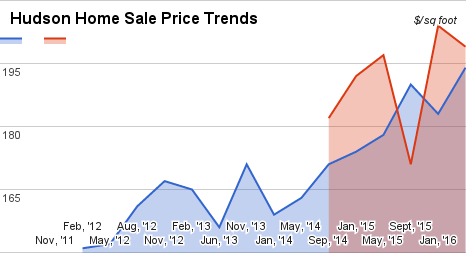
You can see that buyers are paying new high prices as the spring moves along.  The early season saw a pull back, but that's been dwarfed by new purchases, as Hudson moves up to the $200. sq foot mark.

What should active home buyers do in Hudson?

With only 20 properties on the market, it's tough sledding for home buyers in Hudson.  New properties that are coming on are quickly examined, and good values are being bid up in competitive bid situations.  Hudson prices have moved way up since 2014, and it is no longer a deep value town.  Home buyers should be flexible and know their criteria, and may want to expand their search area.

Find Your Next Home or Check out the Competition!


What should potential home sellers do in Hudson?


Hudson Houses For Sale and Sold Market Statistics - MLS Data


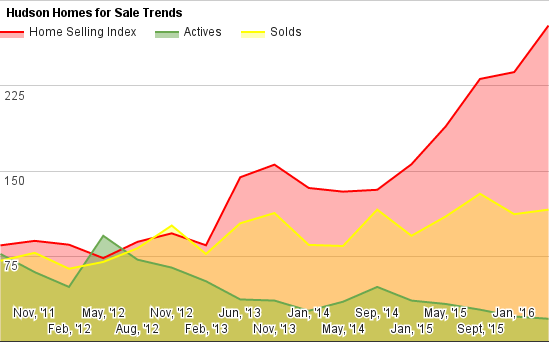
  • The Hudson “Home Seller Index” (HSI): 278 Last Report: 237
  • There are 20 homes actively listed as For Sale for Home Buyers.
  • In the last 6 months, there have been 116 houses sold, and 83 homes sold in the last 3 months

    Remember those who

    have fallen for our Freedom

    in Hudson.
  • The Average number of Days on Market was 33 days for recently SOLD homes.
  • There is an Average Market Time of 70 days of the Hudson homes For Sale (currently for sale).
  • The amount that was paid by Home buyers in Dollars per Square Foot averaged $194 (vs. $183 in the last report)
  • Current home sellers are looking for $199 /sq foot
  • There was an Average Sold Price of $353,584 .
  • Hudson, MA, has 0 properties advertised as lender owned or foreclosure (typically foreclosure) .
  • There are 0 properties advertised as a short-sale is going to be needed by the lender.


All raw data are for Single Family Houses and based on data in MLS. Matt’s HSI is proprietary*, and is designed to offer town-by-town information, instead of large scale trends.

*That means you won’t find it anywhere else. Take that, Case-Schilling!.


Don’t Go Just Yet! More Information for you…

About Matt Heisler

Matt Heisler is a real-estate professional and owner of this website. He has been selling homes in MA for buyers and sellers for over 20 years. He is an expert in foreclosure purchases, short-sale purchases, short-sale sales, buy and hold investing, fix and flip investing, and of course traditional residential home sales. He is happy to take questions as they pertain to real estate on Title V, Radon, Termites, Sump Pumps, Roofs, Foundations, Wells, Septic Systems, Cash-Flow, Staging, and a host of other housing issues. As a Vanderbilt University alumnus, he is proud to serve his local community.

*All information is posted in good faith and is assumed to be reliable, but may rely on third party information sources.

Posted in Hudson, MA
May 27, 2016

Tips for Interviewing a Realtor

Research

Most people put more research into buying a TV or Refrigerator than they do looking for a Realtor. Hello! Your home is pretty expensive. Perhaps, long ago, housing was a very simple industry, but those days are long gone. When you sell a home, you have a few goals. To sell it for as much as is practical, to sell it at an appropriate time frame, and most importantly, to make sure that you are informed about various choices that you'll need to make along the way. There are always choices! Choices about how high to list, what day to list, what month to list, when to do open houses, when to do price changes, how to choose between multiple offers, and what to do during the home inspection. The right real estate agent will give you confidence - and satisfaction - about those choices, and make what is a difficult process that much easier. OK! So now we know why, but how do we choose?

Research On-Line

If you haven't noticed, real-estate marketing has moved to the internet. At this point, that should surprise no one. Your agent should be tech savvy, (more on that below), and one way to find out is to

Don't gamble with your Home Sale.  Interview

Agents and Make sure they Stack up.

research local agents on-line. Most agents do not have very good on-line presences, but some have made it a priority. A good place to start would be Trulia or Zillow, where most agents are rated by stars and have reviews - just like Amazon! Agents that care about their on-line profiles are more likely to be tech savvy, and understand what it takes to market a home today.

Ask Friends

Friends are also a good source of advice. Many times, your friends might say, "Well don't use, Mrs. X", and that would be good information to have. Knowing who was happy after there transaction is a good indicator of how you will feel after it is all done.

Schedule Interviews

Hopefully, you were able to find a few local agents that you can now call and interview. Most agents want to see your home and meet you, to find out your needs and how easy or hard your home will be to sell. Once you've scheduled them, try to keep all the appointments. I recommend you call at least 3, but 5 is good too.


Establish Your Agents Credentials

There are some basic questions to answer here. How many houses do you sell a year? Are you full-time? How many years have you been selling houses? Obviously, you want to avoid agents that do not sell very many houses. Selling a 50 houses a year is not necessarily best either - see below about getting lost in the shuffle - but at the very least you want someone who is not learning on the job. Believe me, seasoned agents will sound and feel very different when you're asking the above questions. Also, was your agent on-time? Did they dress appropriately? Are they pushy? Look for clues as to how important they see you.

Ask What You Need - And What They Offer

Although it can be hard to ask for feedback on your home, and what needs to be done, I advise you to do just that. If three agents mention the same things, those things are likely to be important. Many sellers are surprised when I start giving feedback on the home - many assume things to be important that are not, and vice versa. This is a great time to educate yourself about what buyers are looking for when they will be visiting your home.  If your home needs paint, does the agent know a painter?  A plumber? A stager?  A property manger? Many sellers have specific needs, your agent should be equipped to assist with them.

Look at One of Their listings On-line

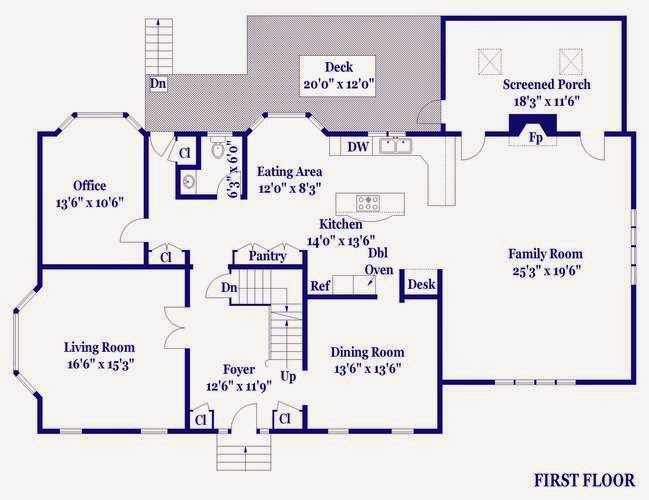
This step is hugely important. Ask about a current listing, and then go look it up on-line. Are the pictures really crisp and clear? Is there a virtual tour? A floor plan? Are their misspellings in the description?

Floor plans are a sign of an agent willing to go the

extra mile when marketing your home.

This is the listing that will drive people to your home, and an agent who doesn't have time to put together a good listing probably won't spend much time on yours. A poor listing can cost you thousands of dollars! So make sure you check.

Make Sure you Don't Get Lost in The Shuffle

The bigger agents in any area - if they sell a lot of houses - will really hammer this point home.  There is little doubt they can sell your home, but still you want it be a good process. A single person can rarely sell more than 20 homes a year - they generally need administrative staff, processes, checklists and the like. If you have a bigger agent, make sure these things are in place, otherwise, you could get lost in the shuffle. Also, bigger agents often take more time off - do they have coverage when they are on vacation? Do they have a trip planned right when you want to list? And lastly, if you're going to be the smallest listing in the agents pile, you are more likely to get substandard service. Agents spend more time with owners of expensive homes - and they are compensated to do so - but there are plenty of good agents who aren't so busy that can make sure you get the attention you deserve.

Are they Tech Savvy?

I've mentioned before, and it is worth repeating. Tech Savvy agents are a must in today's sales world. How can you tell? The best agents will have an active Facebook page, a functioning website, and really a blog or newsletter. These things are crucial in today's connected world, to make sure your home makes the biggest impact. Oddly enough, may of the big franchises are WAY behind the curve when it comes to internet advertising, so don't assume that the big branded name is helping their agents become tech players.

Personality Fit is Crucial

Not every transaction is easy, and when the tough decisions come, you need someone in your corner that you feel good sharing with. Even when things are good, the decision can be hard. If you don't like the person you are dealing with, it is hard to make the transaction work. Also, if you don't like them, other agents - and other buyers - might also get the same *ick* feeling, and that's not good for your sales process. This is a service business, but sadly, many agents are not good at the customer service part. Don't get stuck with someone you can't stand, just because you think they are good at selling homes! There are plenty of agents out there.

Ask What Happens When the Going Gets Tough

Many agents can tell you that your home will sell right away, you'll have multiple offers. All good news. But guess what? Most houses Don't sell right away. So then what happens? What's the back up plan? Ask your agents in interviews what they do when things don't sell. How they answer will tell you a lot about how comfortable they are marketing your home.

Check Prices

There are prices you need to check in your interviews. The price they charge (there is no standard rate, so ask!), and the price they want to put on your house. For most homeowners, this is the most pressing question, but as you can see, it is far from the only one. It is common for most real estate

Multiple price opinions will help

you understand where your home

fits in the marketplace.


agents to take notes, go back to the office and work on a price opinion. Some houses are easy enough to do when you are walking around, but most benefit from careful study. Many agents prefer to come back and show you comparable homes, what they sold for, to help you understand where they are coming from. It is certainly something you want to do if you are getting vastly different prices. Also, beware of agents who are "buying the listing". "Buying" a listing is when an agent suggests the highest price to get the home under contract, and then when it doesn't sell, hammer on you do to price changes. What might that look like? Well if you had four agents in, and they suggest prices of 490, 500, 500, 505, and 530, it is very likely that the 530 is well above market, and your home won't sell. Further, it is likely that the other agents will either defend their prices or list it at 530 - for a time - but with the expectation that if it doesn't sell, you'll bring the price down to where you feel it should be marketed.


Things Not to do


A word about Friends and Relatives

You may have a friend or relative who sell homes. Many people - instead of interviewing agents - work with the friend or relative on the assumption that their home is an easy sale, and they can help their friend. It is OK to work with an agent you know socially, but you should STILL interview them and others. You may find that the relative is a great agent - but doesn't know your area. Or you may find that the friend just does real estate on the side, and has very little experience. But you won't know unless you ask, and you should most definitely ask! You don't want to ruin a relationship because you didn't ask, and if your house doesn't sell, and you are feeling frustrate and confused, that relationship will be tested for sure.  Also, many friends and relatives may not be able to tell you the hard truth about your home, as they don't want to offend you. That's shows they are nice people, but it won't help you when the time comes.


Don't Believe Statements that Are Highly Questionable

If someone says, "I can get you 25,000 more than anyone else", I would consider that highly questionable. Heck if someone could do that, wouldn't everyone use that person? I'd use them! (Who can't use another 25K?). Some agents come with a lot of bravado and bluster. Our job, however, is to market the home, and get people in to see it. Selling the home is really a function of price, presentation, and the market in general. Navigating that nexus is what good agents do - but there aren't a lot of fast and easy answer for most houses. I often say, poor marketing will cost you money, but great marketing isn't likely to get you premium. It is however, going to help make sure you get the maximum you can in your local market, and that's what we're trying to do.


Make Assumptions about Firms

Real Estate Firms are the collective sum of the agents who work there, but agents are really their own business. Once you sign a contract with an agent, they are your only point of contact. Your transaction will go as well - or as poorly - as the agent who represents you. Don't expect the "firm" to bail them out, that's not how it works, and it won't happen. You can't even assume that the agents at larger firms are all well trained! While the larger franchises have plenty of training resources, few agents avail themselves of training, and real estate is sort of a hands-on training business anyway. You can't teach a kid to ride a bike at a seminar, after all.

Don’t Go Just Yet! More Information for you…

About Matt Heisler

Matt Heisler is a real-estate professional and owner of this website. He has been selling homes in MA for buyers and sellers for over 20 years. He is an expert in foreclosure purchases, short-sale purchases, short-sale sales, buy and hold investing, fix and flip investing, and of course traditional residential home sales. He is happy to take questions as they pertain to real estate on Title V, Radon, Termites, Sump Pumps, Roofs, Foundations, Wells, Septic Systems, Cash-Flow, Staging, and a host of other housing issues. As a Vanderbilt University alumnus, he is proud to serve his local community.

*All information is posted in good faith and is assumed to be reliable, but may rely on third party information sources.

Posted in Home Selling